
Our Certificate of Test / Conformance, also called a BMC TR, is available with your order. The metal itself was made by one or more mills, and each mill issues its own certification, often called a mill test report (MTR) or mill cert. Our certificate pulls the key results from those mill certs onto one page and tells you how to trace your material back to them.
A BMC TR, field by field
Here’s an example BMC TR, a section at a time. Supplier and mill names and numbers have been replaced with placeholders.

- 1Certificate NumberThe first six digits are the unique certificate number for this material. The number after the dash is the certificate revision number.
- 2BMC Lot ReceiptOur receiver number, used to identify a lot of material with the same Supplier Reference and the same mechanical and chemical properties.

- 3Your orderSales Order, Customer PO and Job Number tie the certificate to your order.
- 4TypeType, also referred to as alloy or grade, is determined by the chemistry. Several of our items can be dual or triple certified.Read why:304L / 304 / 302302 / 304316 / 316L1008 / 1010
- 5FinishThe Finish shows two values: the finish designation (1BA, 2TR, etc.) and the Ra value, reported in microinches.Read more:FinishesSurface finish Ra

- 6Supplier ReferenceThe supplier’s own identifier for the material we bought. Depending on the Supplier Source, it may be a coil number, tag number, work order number or test number. Together with the Heat Number and the alloy, temper and thickness, it ties our certificate to the rolling mill’s test report.
- 7Supplier Source & Melt Mill Source
- Supplier Source: the mill we bought the material from, which rolled it to the final thickness and temper.
- Melt Mill Source: the mill that melted the metal.
- (Country): the country of origin, shown in parentheses. Use it to confirm DFARS compliance; see What does “DFARS compliant” mean?
- 8Heat NumberThe number given to the batch of metal when it was melted. It stays with the metal through rolling and slitting, so it appears on every certification for your material and on the label attached to your material.

- 9Your part number, UNS numbers & specificationsYour own part number (Cust. Part No.) appears here, along with the UNS number for each grade and the specifications the material is certified to.
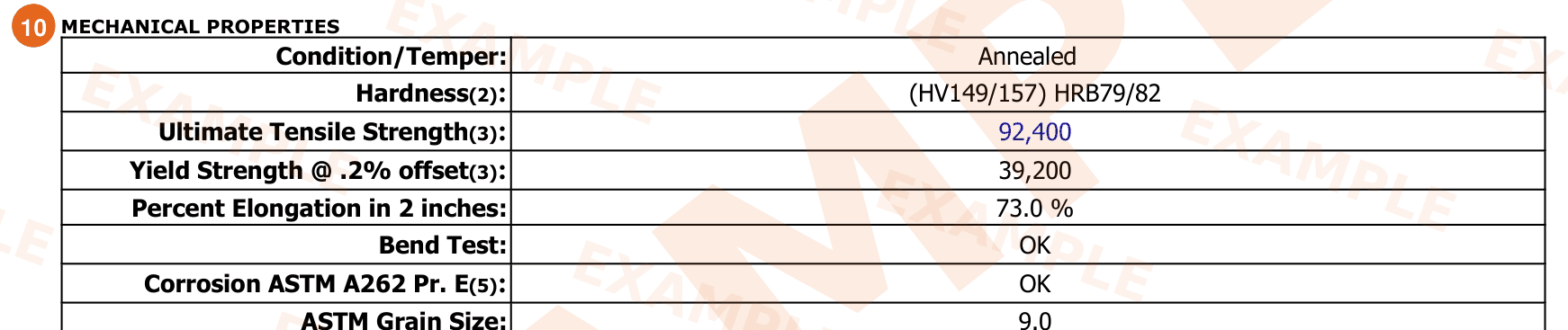
- 10Mechanical propertiesTemper, tensile and yield strength, elongation and other test results. These properties are provided by the Supplier Source, the mill that rolled the material to its final thickness and temper. Tensile and yield strength are reported in PSI.

- 11Chemical propertiesThe chemistry of the heat, in weight percent. The chemistry is what determines the Type (alloy or grade) shown in #4. These values come from the Melt Mill Source and are repeated on the Supplier Source’s mill test report.

- 12The fine print – statements & complianceThe fine print at the bottom of the certificate is worth reading. Along with the certificate type (EN 10204 3.1), it includes:
- Conformance: we certify that the information on the certificate is a true copy of the data on file and that the material conforms to the specifications listed.
- No welds: no welds or weld repairs, except on oscillate wound coils and spools when agreed on with the customer.
- Mercury free: Brown Metals Company does not use mercury in the production of its products.
- Anti-fraud: federal law prohibits recording false, fictitious or fraudulent statements or entries on the certificate.
- More statements of compliance and downloads: a link to our Compliance Document Library, which includes AS9100 / ISO 9001, RoHS, REACH, SDS, Conflict Minerals and more.
Two kinds of mills
How our certificate ties to the mill certs depends on the kind of mill the material came from.
- A fully integrated mill melts and rolls the metal to the final thickness and temper. The Supplier Source and Melt Mill Source will be the same name on the BMC TR. This mill’s single certification covers both the melt and rolling operations.
- A conversion mill buys band stock from a melt mill and rolls it to the final thickness and temper. Supplier Source is the conversion mill and Melt Mill Source is the melt mill, so the material has two mill certs: one from each.
What changes between the melt mill cert and the conversion mill cert
When a conversion mill re-rolls band stock down to the final thickness and temper, it changes the material. The thickness, temper and mechanical properties on the melt mill’s cert describe the band stock as it was melted and first rolled, not the material you received. The conversion mill’s cert reports the new values, and those are the ones on our certificate.
Three things on the melt mill’s cert don’t change, and these are the ones to look for:
- Heat NumberThe same heat number appears on the melt mill's cert, the conversion mill's cert and our certificate.
- ChemistryRe-rolling doesn't change the chemistry, so the melt mill's values carry through to your material.
- Melt locationThe country where the metal was melted, such as USA. This is what DFARS compliance is based on.
Same number, different names
Every mill lays out its cert differently, and they don’t all use the same labels. These are the names to look for:
| On our certificate | On a mill cert, it may be labeled |
|---|---|
| Supplier Reference | Coil No., Tag No., Work Order No. or Test No. |
| Heat Number | Heat No., Melt No., Cast No. or Heat / Lot |
| Melt Mill Source | Melted by, Melt Shop or the mill’s name in the letterhead of the melt mill cert |
RoHS, REACH and other compliance documents
Statements that apply to all of our material, rather than to one heat, aren’t repeated on every certificate. The certificate points to www.brownmetals.com/compliance, which opens our Compliance Document Library. There you’ll find our OSHA, AS9100, ISO 9001, SDS, RoHS, REACH and other statements of compliance.
Mill test reports
The data on our certificate is derived directly from the mill test reports. Mill test reports are available upon request.
This article is educational information only. The certificate shown is an example; supplier and mill names and numbers have been replaced with placeholders. Field names and layouts on mill certifications vary by mill.