
Even a surface that looks mirror-smooth is a landscape of tiny peaks and valleys when you magnify it. Ra — short for roughness average — boils that landscape down to one number, and it’s the surface finish value many mills report on their test reports.
What Ra measures
Imagine a line drawn through the middle of the surface profile, so that the area of the peaks above it equals the area of the valleys below it. That is the mean line. Ra is the average distance between the surface and that line, with every distance counted as positive — peaks and valleys alike.
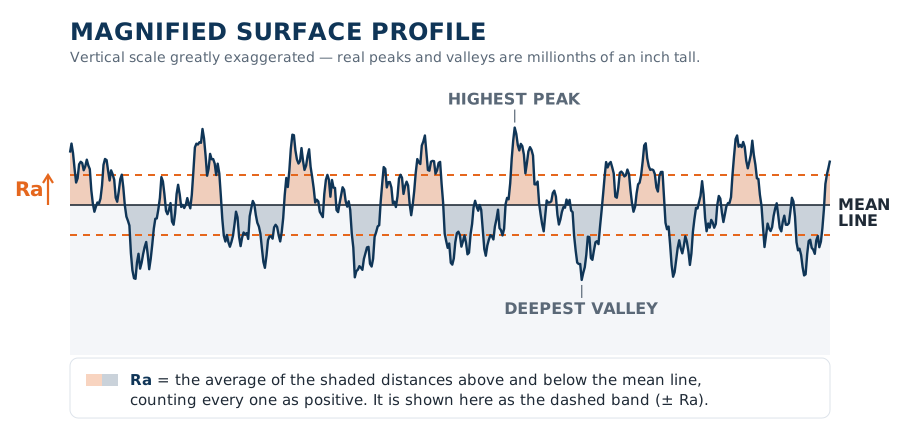
So Ra isn’t quite the “average height” of the surface — by definition, the average height is the mean line. Ra is the average amount the surface departs from it.
How to read the number
- Lower is smoother. A smaller Ra means the peaks and valleys sit closer to the mean line.
- Check the units. Our suppliers report Ra in microinches (µin), and so do we. If your drawing gives Ra in micrometers (µm) instead, multiply by 39.37 to convert: 0.25 µm is about 10 µin.
- Keep the scale in mind. One microinch is one-millionth of an inch. A strip .001″ thick is 1,000 microinches thick — so an Ra of 10 µin describes texture far finer than the thickness of even our thinnest material.
- Direction matters. On rolled strip, a reading taken across the rolling direction (transverse) is usually higher than one taken along it (longitudinal). Our suppliers report Ra in the transverse direction, so the values we provide reflect that.
How it’s measured
Ra is most often measured with a profilometer: a fine stylus is drawn across the surface over a set distance, and the instrument records the peaks and valleys it rides over and calculates the average. Optical instruments can measure it too. The measuring length and instrument settings affect the result, so readings taken under different settings may not compare directly.
Why it’s important
Surface texture affects how a part looks and how it behaves, which is why Ra appears on so many drawings and specifications. It commonly comes up when a surface needs to:
- Look a certain way — brightness and reflectivity
- Hold a coating, plating, paint or adhesive
- Etch, laser-mark or photo-etch consistently
- Clean easily, as on food-processing and medical equipment
- Seal against a gasket or slide against another part
In general, a bright annealed (1BA) finish has a lower Ra than a dull (2D) finish. See what finishes you can expect on the material we stock.
What Ra doesn’t tell you
Because Ra is an average, very different surfaces can share the same number. A gently rolling surface and a flat surface with a few sharp peaks and deep scratches can have identical Ra values.
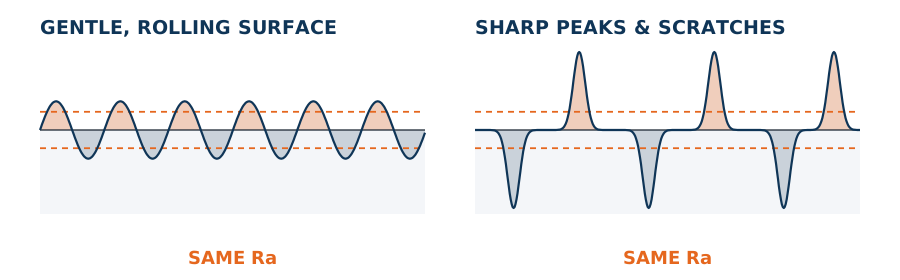
That’s why some specifications add other parameters, such as Rz (the average peak-to-valley height) or a limit on the highest peaks, alongside or instead of Ra.
Ra and your order
Your drawing or specification sets the surface finish requirement. If it calls for a maximum Ra, include the value, its units and any measurement direction with your request for quote, so we can confirm what is available before you order.
This article is educational information only. Surface finish values vary by mill, product and lot.