
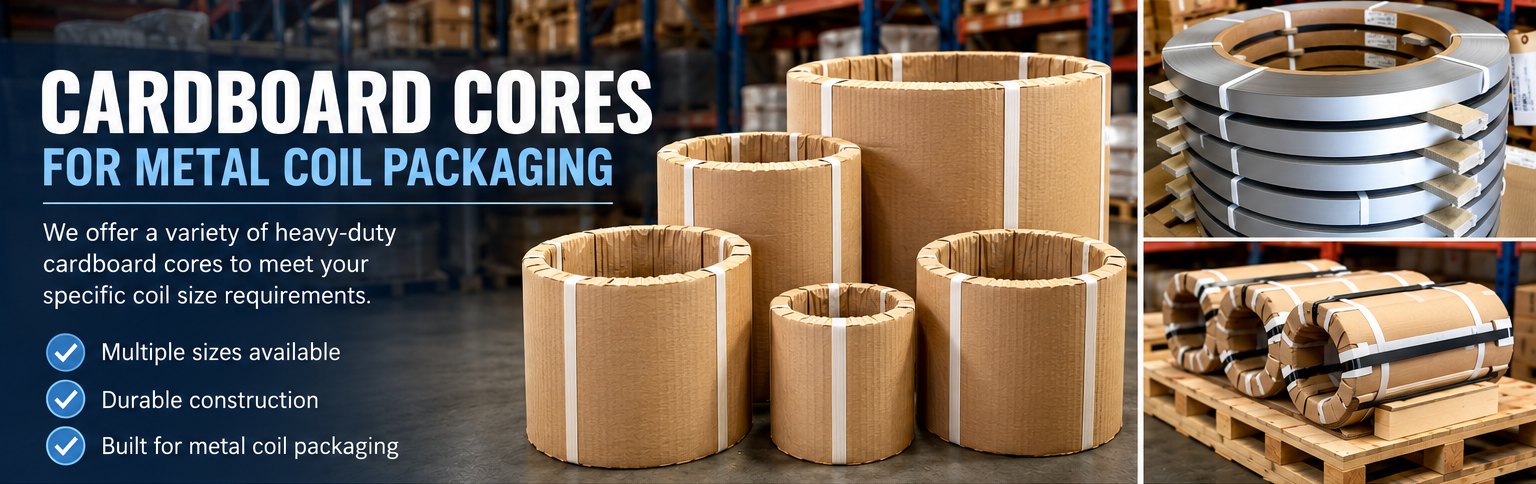
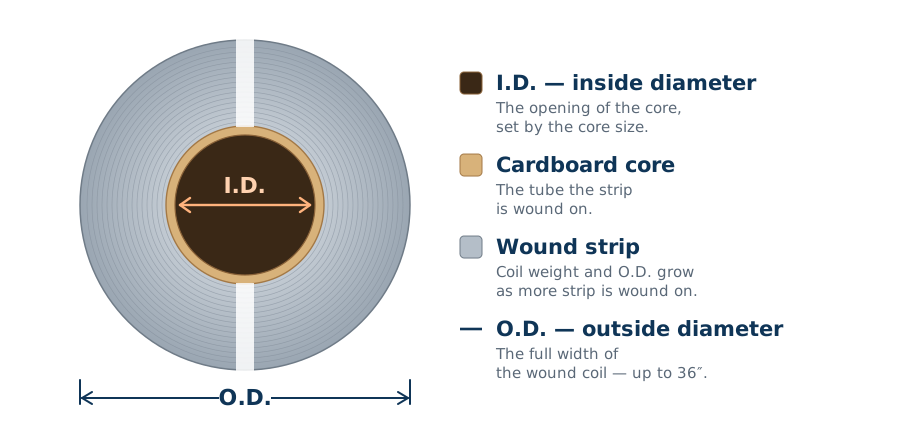
Every coil we ship is wound around a cardboard core — a sturdy tube that gives the coil a round, open center. The size of that opening is the coil’s inside diameter, or I.D., and the core you choose sets it.
I.D. and O.D.
Two measurements describe a coil’s size:
- I.D. (inside diameter) — the opening in the middle, set by the core the coil is wound on.
- O.D. (outside diameter) — the full width of the wound coil. It grows as more strip is wound on, so it goes hand in hand with coil weight. Our maximum coil O.D. is 36″.
The core sizes we use
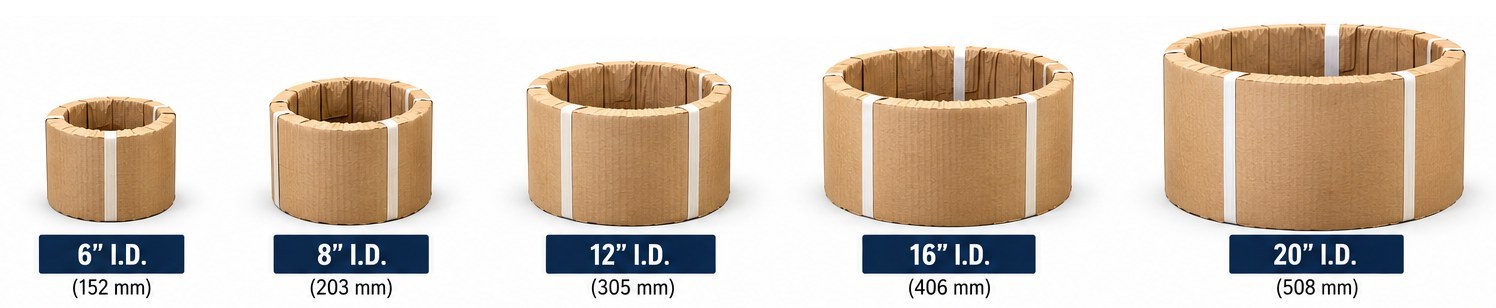
We wind coils on 6″, 8″, 12″, 16″ and 20″ I.D. cardboard cores.
The two cores we use most often depend on the thickness of the material:
Typically used for material under .012″ thick.
Typically used for material .012″ thick and over.
Why thicker material goes on a larger core
Winding strip around a core bends it into a curve. The thicker the strip, the more a tight curve bends it — so thicker material is wound on a larger core, which gives it a gentler curve. Thin material bends easily, so it winds well on a smaller core and makes a more compact coil.
Matching the core to your equipment
The I.D. you need often comes down to your own equipment. A coil has to fit the mandrel or payoff reel that unwinds it on your line, so many customers specify the I.D. their equipment takes.
Specifying coil size on your order
When you request a quote or place an order, include:
- Coil I.D., if your equipment needs a specific size
- Maximum O.D. or coil weight, if your equipment or handling has a limit (our maximum O.D. is 36″)
If you don’t specify an I.D., we’ll use our typical core for the thickness. See what to include in a request for quote for the full list.
This article is educational information only. Core size, coil O.D. and coil weight are confirmed with each order.